Video Gaming and Cybersecurity: Navigating Legal and Technological Challenges

Video gaming industry faces significant cyber risks due to rapid growth, attracting cyber criminals. Regulators worldwide are extending critical infrastructure legislation to gaming. This includes the NIS2 Directive and Cyber Resilience Act which impose stringent cybersecurity requirements on game companies. Key risks involve in-game integrity, data breaches, and compliance with regulations like GDPR. Effective cybersecurity measures are essential for legal compliance and to maintain user trust in an evolving digital landscape.

https://www.nortonrosefulbright.com/en/knowledge/publications/77cbcb67/video-gaming-and-cybersecurity

FBI Reports $262M in ATO Fraud as Researchers Cite Growing AI Phishing and Holiday Scams

FBI reports over $262M lost to account takeover (ATO) fraud this year, targeting various sectors through social engineering and phishing. Cybercriminals impersonate financial institutions to steal sensitive information and funds. Users are advised to monitor accounts and protect personal information. The rise of AI in phishing tactics is linked to increased holiday scams, with significant vulnerabilities exploited across e-commerce platforms. A shift towards sophisticated purchase scams is noted, involving authorized payments by victims, complicating fraud detection.

https://thehackernews.com/2025/11/fbi-reports-262m-in-ato-fraud-as.html

Google Antigravity Exfiltrates Data

Google's Antigravity allows for data exfiltration through indirect prompt injection, enabling attackers to manipulate the software to steal sensitive user data from IDEs. In an attack scenario, a user integrating Oracle ERP's AI Payer Agents exposes their credentials as Antigravity accesses a malicious site via a hidden prompt injection. Despite safeguards, the tool bypasses protections to exfiltrate data, showcasing serious vulnerabilities linked to its design and settings. Google's acknowledgment of these risks highlights the need for user vigilance amidst multiple agents operating simultaneously.

https://www.promptarmor.com/resources/google-antigravity-exfiltrates-data

Email Security: Where We Are and What the Future Holds

Email security is flawed, relying on outdated protocols like SMTP, which lacks encryption by default. Various solutions like STARTTLS, SMTPS, and end-to-end encryption via PGP and S/MIME attempt to improve security but face usability and trust issues. Authentication mechanisms (SPF, DKIM, DMARC) help but are vulnerable due to DNS weaknesses. The future calls for enhanced E2EE, adoption of DNSSEC, and overall improvements in protocols to strengthen email as a secure communication tool, moving away from its role in account recovery and toward focused communication purposes.

https://www.privacyguides.org/posts/2025/11/15/email-security-where-we-are-and-what-the-future-holds/

Technology Protects Retailers, Issuers, and Consumers From CNP Fraud

Card-not-present (CNP) fraud significantly impacts merchants, especially in e-commerce, with most of the financial liability falling on retailers. Solutions like Safecypher’s dynamic security code use temporary CVVs visible only in secure banking apps, offering two-factor authentication at purchase and preventing unauthorized use even with stolen card details. Results from the Irish Post Office show this approach eliminated CNP fraud when adopted by customers.

https://www.marketingtechnews.net/news/cnp-fraud-foiled-by-banking-app-mfa/

Matrix Push C2 Abuses Browser Notifications to Deliver Phishing and Malware

Cybercriminals exploit browser push notifications via the Matrix Push C2 platform to deliver malware and phishing attacks. Users are deceived into granting permission through misleading prompts, allowing attackers to send fake alerts and gather personal data. The platform enables detailed monitoring of victims and custom URL management for malicious campaigns, often resulting in data theft or financial loss. Users are advised to manage notification permissions across their browsers to mitigate these risks.

https://www.malwarebytes.com/blog/news/2025/11/matrix-push-c2-abuses-browser-notifications-to-deliver-phishing-and-malware

ClickFix Gets Creative: Malware Buried in Images

ClickFix malware is a multi-stage attack using steganography to conceal infostealing malware within images. It begins with social engineering tactics, tricking users into executing malicious commands. Huntress identified two main ClickFix lures—one using a “Human Verification” tactic and the other mimicking a Windows Update interface. The process involves JavaScript to copy commands to the clipboard, PowerShell for loading .NET assemblies, and a complex steganographic algorithm to hide and extract shellcode from PNG images. This shellcode is then injected into target processes, ultimately delivering LummaC2 malware for data theft. The campaign has evolved with increasingly convincing user interfaces to deceive targets effectively.

https://www.huntress.com/blog/clickfix-malware-buried-in-images

Sha1-Hulud 2.0 Supply Chain Attack: 25K+ Npm Repos Exposed

Extreme TLDR:
New Shai-Hulud 2.0 attack targets npm packages, affecting 25K+ repos and stealing secrets, with ~700 compromised packages identified. Immediate investigation and remediation recommended for npm environments. Attackers exploit lifecycle scripts for credential theft, leading to widespread credential exfiltration and propagation. Security teams advised to replace compromised packages, rotate credentials, and audit CI/CD environments.

https://www.wiz.io/blog/shai-hulud-2-0-ongoing-supply-chain-attack

Fake Calendar Invites Are Spreading. Here’s How to Remove Them and Prevent More

Fake calendar invites are on the rise, often linked to phishing scams that users struggle to delete due to synchronization across devices. To remove these, disable auto-adding events in settings for Outlook, Gmail, and mobile calendars, block senders, and report spam. Precautions include avoiding interaction with unknown invites, limiting calendar permissions, and using anti-malware tools. Always verify billing issues through official channels.

https://www.malwarebytes.com/blog/news/2025/11/fake-calendar-invites-are-spreading-heres-how-to-remove-them-and-prevent-more

WhatsApp API Flaw Let Researchers Scrape 3.5 Billion Accounts

WhatsApp's contact-discovery API had a flaw allowing researchers to scrape 3.5 billion accounts due to lack of rate limiting, enabling high-volume queries. This study highlighted vulnerabilities in API security across platforms. Researchers gathered extensive user data, including profiles, revealing large-scale abuse potential. WhatsApp subsequently implemented protections to prevent further exploitation.

https://www.bleepingcomputer.com/news/security/whatsapp-api-flaw-let-researchers-scrape-35-billion-accounts/

Understanding Cloud Persistence: How Attackers Maintain Access Using Google Cloud Functions

Extreme TLDR: Attackers use Google Cloud Functions and service accounts to maintain access in cloud environments. They automate recovery of deleted accounts through logging and Pub/Sub events, leveraging these features for persistent access despite clean-up efforts.

https://whiteknightlabs.com/2025/11/11/understanding-cloud-persistence-how-attackers-maintain-access-using-google-cloud-functions/

How Consumers See Card Threats

Many card users lack recent security awareness, with a J.D. Power survey revealing that a third haven't taken protective measures in 90 days. 24% faced fraud, mainly Gen Z (41%) and financially strapped consumers (40%). Only 45% reported prompts from issuers for security actions. As fraud losses may total $403.88 billion globally over the next decade, institutions stress consumer responsibility in fraud prevention.

https://www.paymentsdive.com/news/consumers-want-more-card-fraud-protection-survey/806174/

Kevin Boone: The Privacy Nightmare of Browser Fingerprinting

Summary: Browser fingerprinting compromises online privacy by creating unique identifiers from browser information, making tracking harder to evade than traditional cookies. While steps like using VPNs and popular browsers can mitigate risks, effective resistance is challenging and often inconvenient. Legal clarity on fingerprinting is lacking, and stronger legislation is needed to address its privacy threats. Overall, fingerprinting remains a significant concern, contributing to intrusive advertising practices.

https://kevinboone.me/fingerprinting.html

Sturnus: Mobile Banking Malware Bypassing WhatsApp, Telegram and Signal Encryption

Sturnus is a newly identified Android banking trojan capable of bypassing encrypted messaging apps like WhatsApp, Telegram, and Signal. It monitors communications by capturing screen content, harvests banking credentials via fake login screens, and allows extensive remote control of infected devices, including real-time screen viewing and activity injections. Currently in a pre-deployment phase, it primarily targets users in Southern and Central Europe, focusing on high-value applications. The malware's architecture incorporates advanced evasion techniques, including code obfuscation and complex communication protocols, posing significant threats to financial security and privacy.

https://www.threatfabric.com/blogs/sturnus-banking-trojan-bypassing-whatsapp-telegram-and-signal

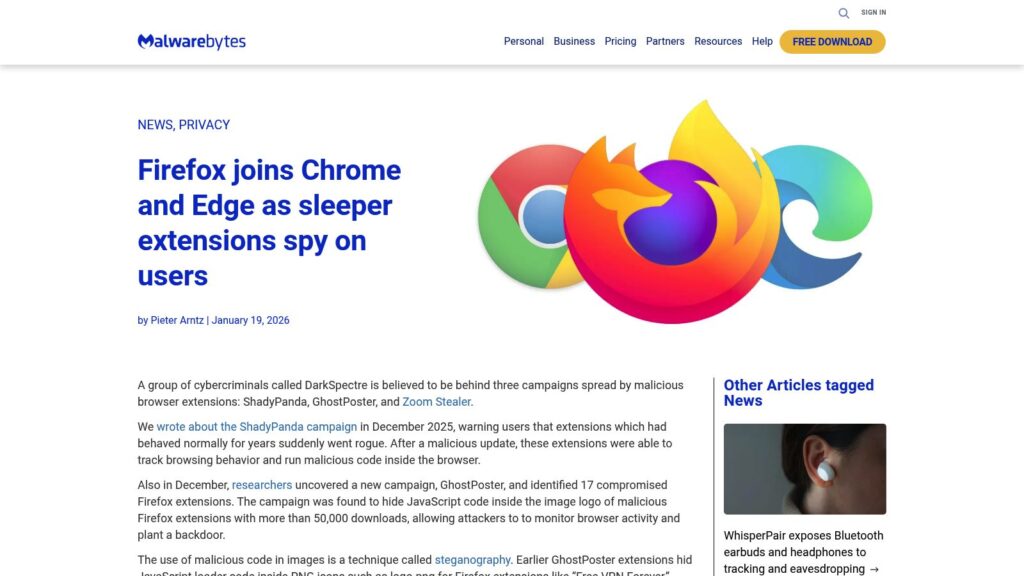
‘MatrixPush’ C2 Tool Hijacks Browser Notifications

A recent cyber threat, “Matrix Push,” uses browser notifications for phishing attacks, exploiting legitimate API requests. Infections happen through social engineering, allowing attackers to send deceptive alerts disguised as genuine notifications. To combat these threats, stronger browser protections, user vigilance, and security tools are essential.

https://www.darkreading.com/threat-intelligence/matrix-push-c2-tool-hijacks-browser-notifications-phishing

Scroll to Top