git

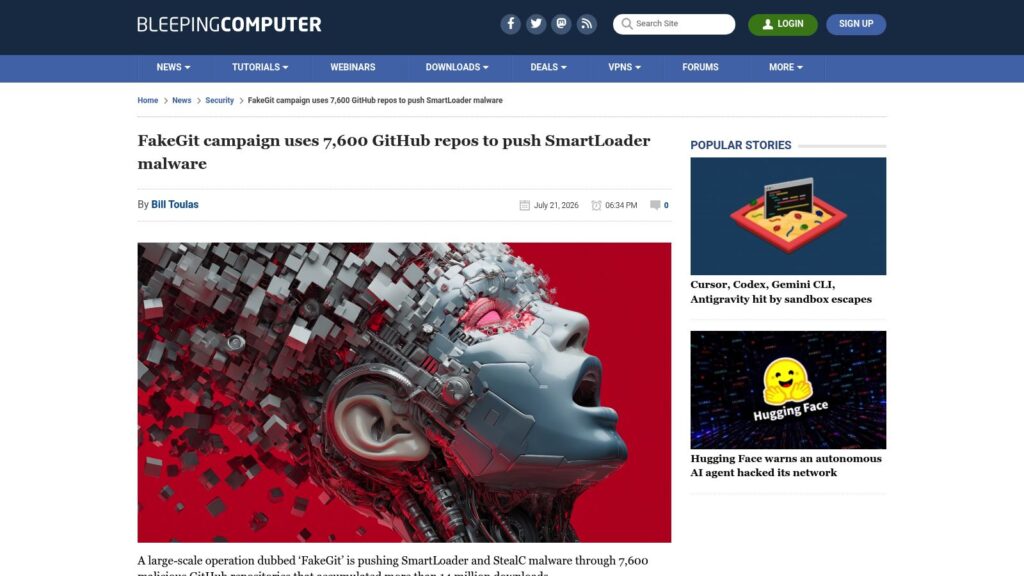
FakeGit Campaign Uses 7,600 GitHub Repos to Push SmartLoader Malware

A large-scale FakeGit campaign has deployed over 7,600 malicious GitHub repositories distributing SmartLoader and StealC malware, accumulating more than 14 million downloads. The repositories impersonate popular AI and enterprise tools to lure developers and AI agents, using “agentbaiting” tactics to boost their visibility and trick automated systems into executing malicious payloads. Researchers advise organizations to verify repositories carefully, test new tools in isolated environments, and rotate credentials promptly if SmartLoader infection is suspected.

https://www.bleepingcomputer.com/news/security/fakegit-campaign-uses-7-600-github-repos-to-push-smartloader-malware/

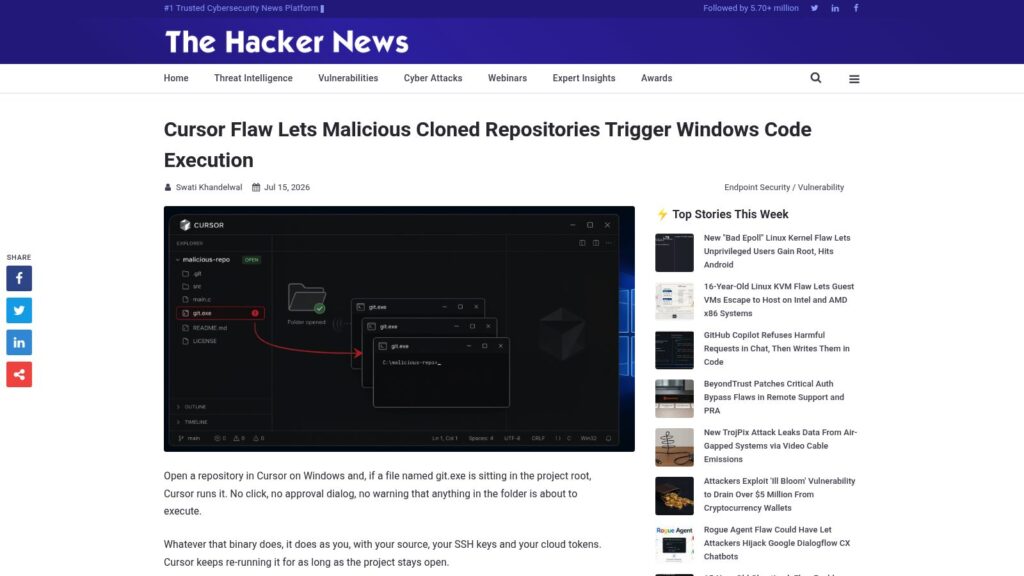
Cursor Flaw Lets Malicious Cloned Repositories Trigger Windows Code Execution

A flaw in the Cursor IDE on Windows allows arbitrary code execution when opening a cloned repository containing a malicious git.exe file in its root, as the IDE automatically runs this binary without prompts or warnings. Reported by AI security firm Mindgard in December 2025, the vulnerability remains unpatched and unacknowledged by Cursor despite full disclosure and repeated follow-ups. Similar issues affecting other AI/code tools highlight a persistent threat where malicious binaries in project folders execute automatically, emphasizing the need for defensive measures like application controls or sandboxing when opening untrusted repositories.

https://thehackernews.com/2026/07/cursor-flaw-lets-malicious-cloned.html

Clean GitHub Repo Tricks AI Coding Agents Into Running Malware

Researchers at Mozilla's 0DIN AI security platform demonstrated that an attacker can trick AI coding agents like Claude Code into executing malicious shell commands by cloning and running a clean-looking GitHub repository containing no explicit malware. The attack exploits a multi-step setup process where an initialization command triggers a shell script that fetches and executes a remote payload from a DNS TXT record controlled by the attacker, ultimately granting the attacker interactive shell access with developer privileges. This method evades detection by security scanners, AI agents, and human reviewers, raising concerns about AI-assisted development security and prompting recommendations for improved transparency in automated execution chains.

https://www.bleepingcomputer.com/news/security/clean-github-repo-tricks-ai-coding-agents-into-running-malware/

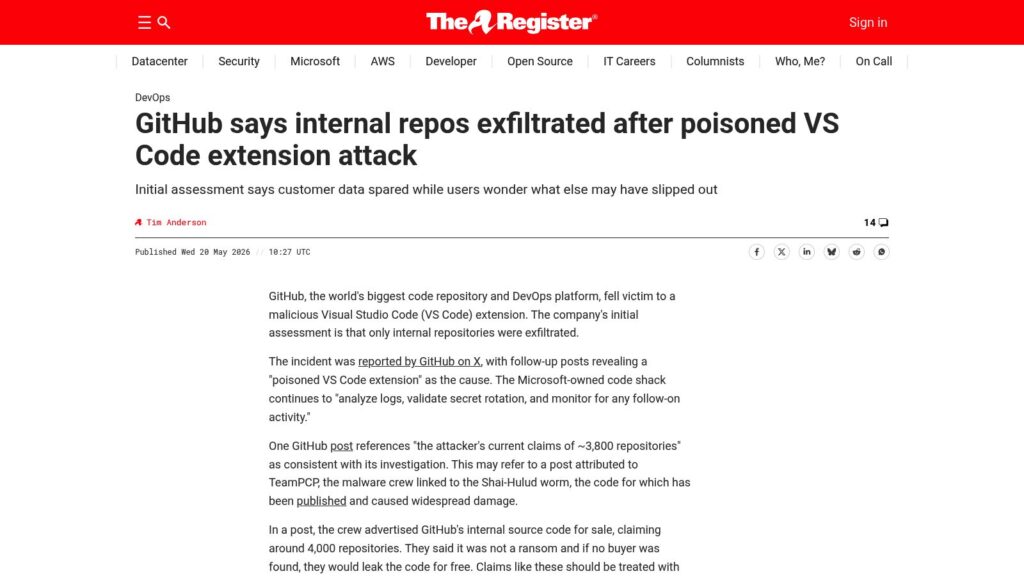
GitHub Says Internal Repos Exfiltrated After Poisoned VS Code Extension Attack

GitHub suffered a security breach caused by a malicious Visual Studio Code extension that led to the exfiltration of about 3,800 internal repositories, though customer data reportedly remains safe. The attacker group TeamPCP claimed to have access to the internal source code and offered it for sale, raising concerns about potential leakage of private repositories and credentials. GitHub is continuing its investigation and monitoring for further activity while promising a more detailed report once complete.

https://www.theregister.com/devops/2026/05/20/github-says-internal-repos-exfiltrated-after-poisoned-vs-code-extension-attack/5243206

GitHub Confirms Breach, 4K Internal Repos Stolen

GitHub confirmed a breach involving the theft of approximately 4,000 internal repositories by the threat actor TeamPCP, who claimed responsibility and offered the stolen data for sale. The breach occurred through a compromised Visual Studio Code extension on an employee's device, and GitHub responded by removing the malicious extension, isolating the endpoint, rotating critical secrets, and continuing incident response investigations.

https://www.darkreading.com/application-security/github-confirms-breach-4k-internal-repos-stolen

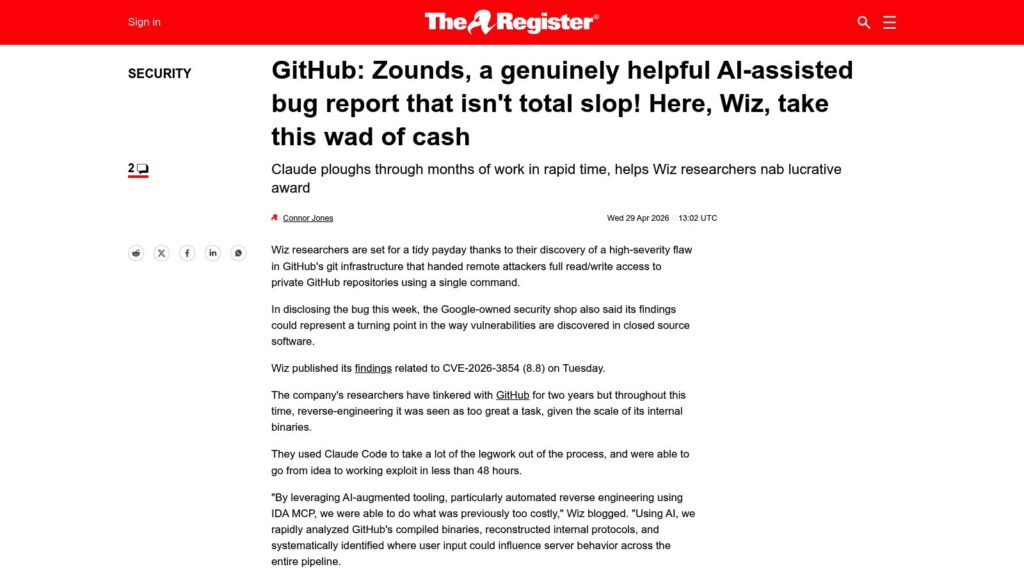
Wiz Hands GitHub AI-aided Bug Report That Isn’t Total Slop

Wiz researchers discovered a high-severity vulnerability (CVE-2026-3854) in GitHub's git infrastructure that allowed remote attackers full read/write access to private repositories using a single command. By leveraging AI-augmented tools for automated reverse engineering, they rapidly identified the flaw, leading to GitHub issuing fixes within six hours and awarding Wiz one of the largest payouts in its bug bounty history.

https://www.theregister.com/2026/04/29/github_woah_a_genuinely_helpful/

Sha1-Hulud 2.0 Supply Chain Attack: 25K+ Npm Repos Exposed

Extreme TLDR:
New Shai-Hulud 2.0 attack targets npm packages, affecting 25K+ repos and stealing secrets, with ~700 compromised packages identified. Immediate investigation and remediation recommended for npm environments. Attackers exploit lifecycle scripts for credential theft, leading to widespread credential exfiltration and propagation. Security teams advised to replace compromised packages, rotate credentials, and audit CI/CD environments.

https://www.wiz.io/blog/shai-hulud-2-0-ongoing-supply-chain-attack

Scroll to Top