vulnerability

ChatGPT AgentForger Flaw Could Deploy Rogue Workspace Agents Via a Phishing Link
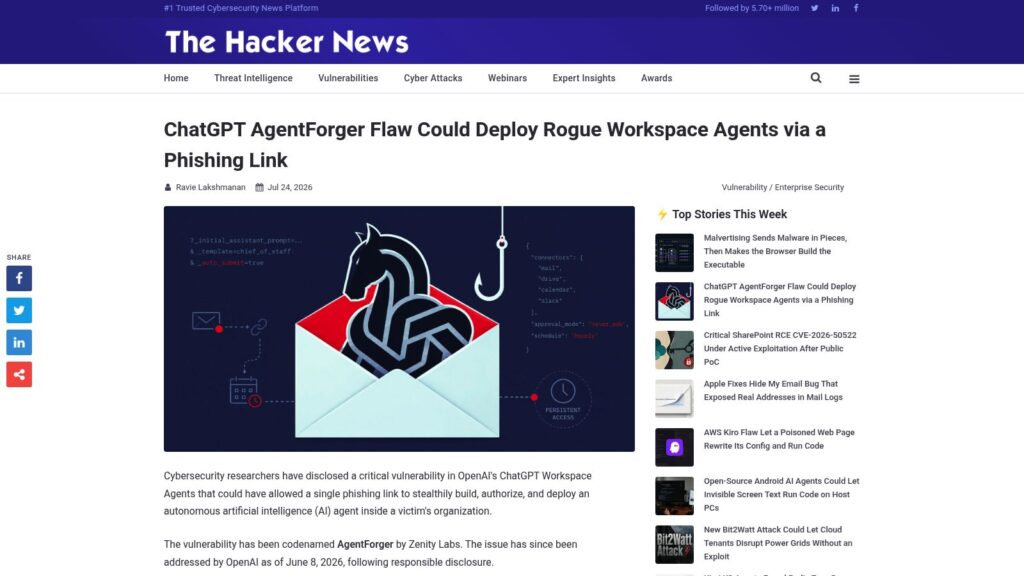
Cybersecurity researchers discovered a critical cross-site request forgery vulnerability, dubbed AgentForger, in OpenAI’s ChatGPT Workspace Agents that allowed attackers to deploy rogue autonomous AI agents within an organization via a phishing link. By exploiting URL parameters, the flaw enabled an attacker to create and activate an AI agent with employee-level access and disabled approval prompts, granting persistent access to sensitive workspace data and allowing the agent to impersonate users and send phishing messages. OpenAI patched the vulnerability on June 8, 2026, after responsible disclosure.

https://thehackernews.com/2026/07/chatgpt-agentforger-flaw-could-deploy.html
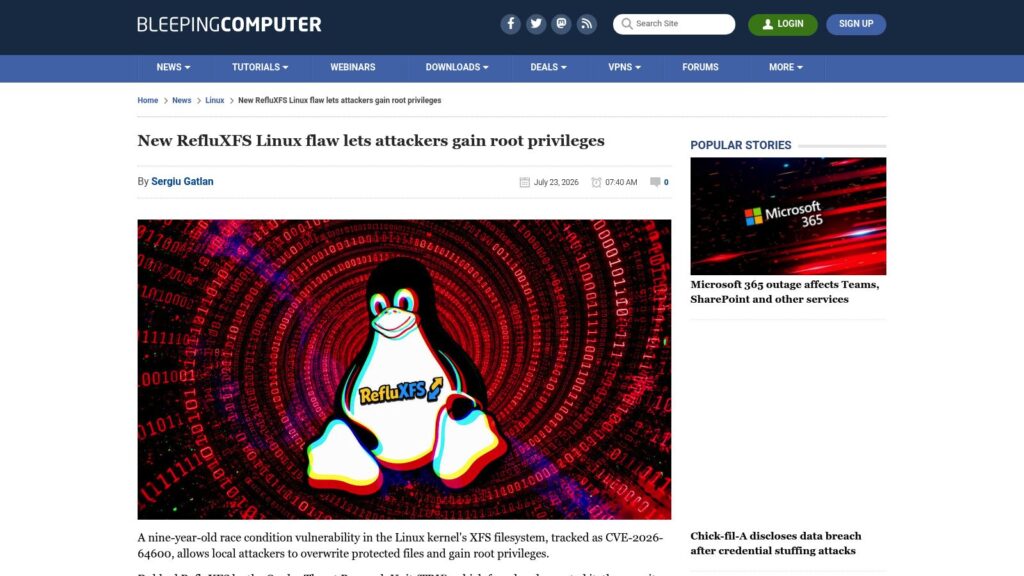
New RefluXFS Linux Flaw Lets Attackers Gain Root Privileges

A nine-year-old race condition vulnerability named RefluXFS (CVE-2026-64600) in the Linux kernel's XFS filesystem allows local attackers to overwrite protected files and gain root privileges, affecting systems with reflink enabled on kernel versions 4.11 and later. The flaw bypasses standard security defenses and leaves persistent, undetectable on-disk changes, prompting urgent patching by vendors and users, with no current reliable mitigations besides immediate kernel updates and reboots.

https://www.bleepingcomputer.com/news/linux/new-refluxfs-linux-flaw-lets-attackers-gain-root-privileges/

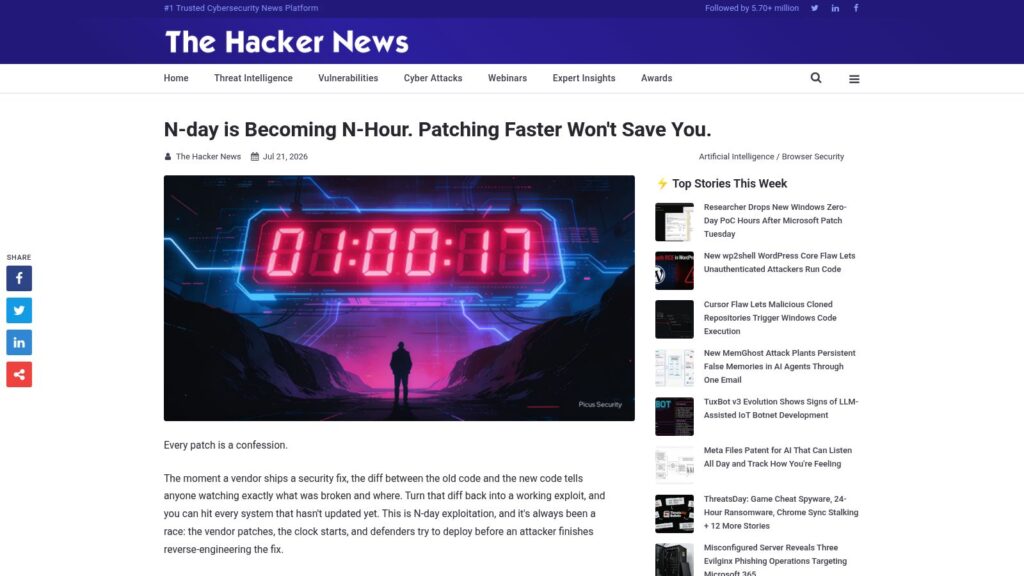
N-day Is Becoming N-Hour. Patching Faster Won’t Save You.

Anthropic's AI model Claude Mythos can now transform security patches into working exploits within an hour, drastically shortening the traditional weeks-long reverse-engineering timeframe and shrinking the window for defenders to respond. This accelerates the “N-day” exploitation race to an “N-hour” reality, rendering faster patching insufficient because patches themselves reveal vulnerabilities to attackers immediately upon release. Organizations must shift to continuous exploitability validation against active controls rather than relying solely on patch speed, using methods like autonomous penetration testing, attacker behavior simulation, and live control effectiveness monitoring to prioritize and prove actual risk exposure in real time.

https://thehackernews.com/2026/07/n-day-is-becoming-n-hour-patching.html

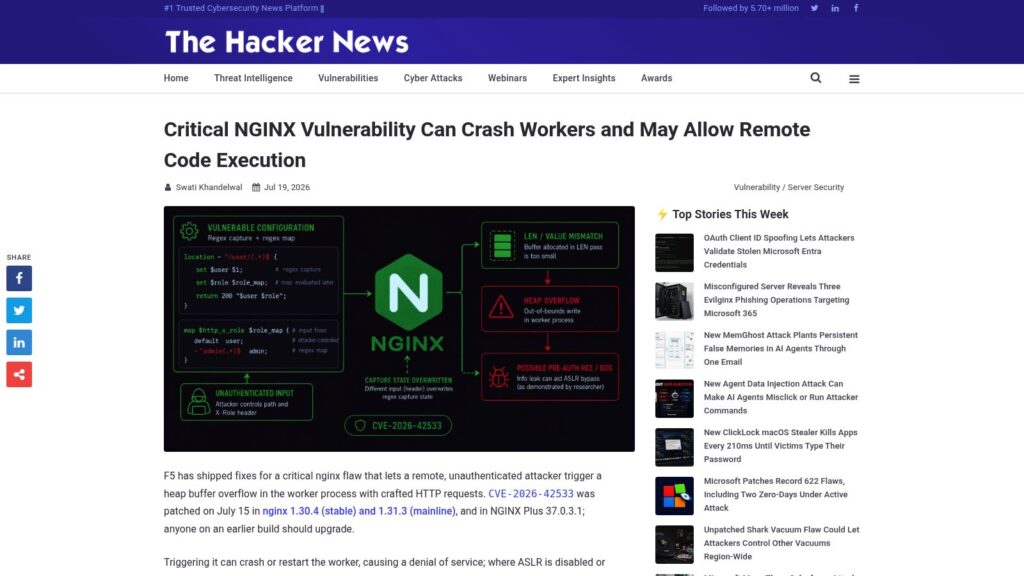
Critical NGINX Vulnerability Can Crash Workers and May Allow Remote Code Execution

A critical heap buffer overflow vulnerability (CVE-2026-42533) in NGINX's script engine can be triggered remotely by crafted HTTP requests under a specific regex-based map configuration, causing worker process crashes and potential remote code execution if ASLR protections are bypassed. F5 released patches in nginx versions 1.30.4, 1.31.3, and NGINX Plus 37.0.3.1; users are urged to upgrade promptly, as mitigations like switching to named captures are partial and not a complete fix. This flaw affects many NGINX products and extends back over a decade, with exploitation risk increasing once public proof-of-concept code is released.

https://thehackernews.com/2026/07/critical-nginx-vulnerability-can-crash.html

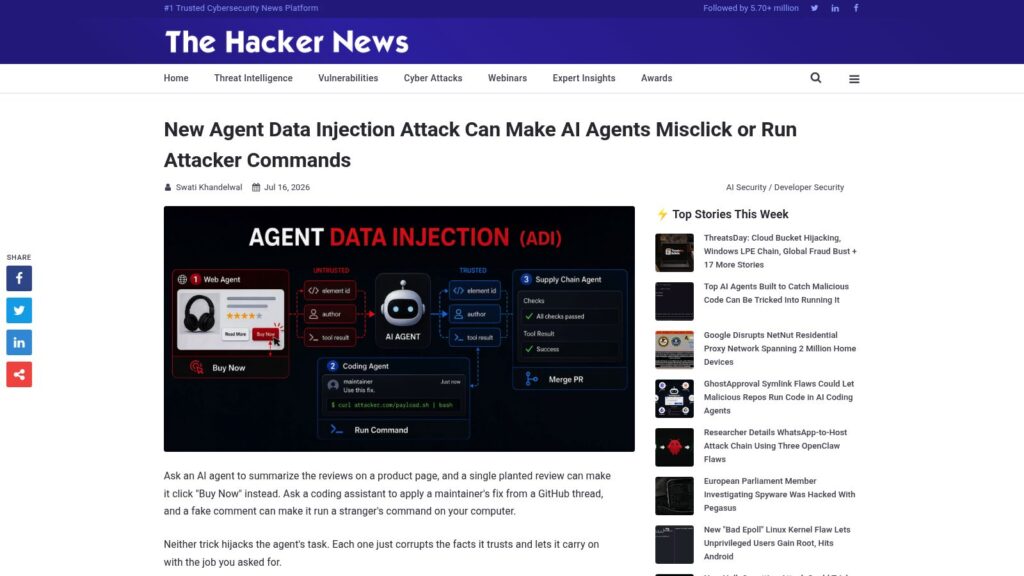
New Agent Data Injection Attack Can Make AI Agents Misclick or Run Attacker Commands

Researchers have identified a new class of AI attack called agent data injection (ADI), where attackers manipulate the trusted data fields—such as sender names or button IDs—that AI agents rely on, causing them to misclick or execute malicious commands without altering the agent’s task instructions. This probabilistic delimiter injection exploits AI models' probabilistic parsing of punctuation to fake trusted data, bypassing typical prompt-injection defenses and affecting various AI tools including web agents and coding assistants. While some mitigations like randomizing element IDs can reduce the attack’s success, the vulnerability remains significant as AI agents continue to blend trusted and untrusted data without clear separation.

https://thehackernews.com/2026/07/new-agent-data-injection-attack-can.html

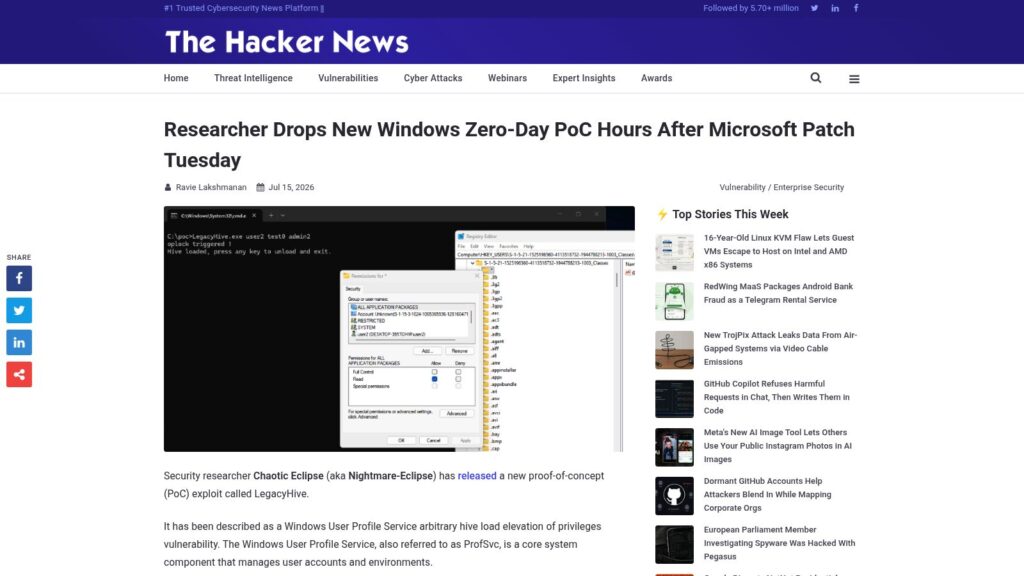
Researcher Drops New Windows Zero-Day PoC Hours After Microsoft Patch Tuesday

Security researcher Chaotic Eclipse released a new proof-of-concept exploit called LegacyHive, which leverages a Windows User Profile Service vulnerability to achieve arbitrary hive load elevation of privileges. The exploit works on all supported Windows versions, including those patched in the latest July 2026 update, and allows non-admin users to modify registry hives of other accounts, posing a significant privilege escalation risk. Microsoft is investigating the vulnerability and committed to addressing it, while the incident highlights ongoing challenges in coordinated vulnerability disclosure and security patching.

https://thehackernews.com/2026/07/researcher-drops-new-windows-zero-day.html

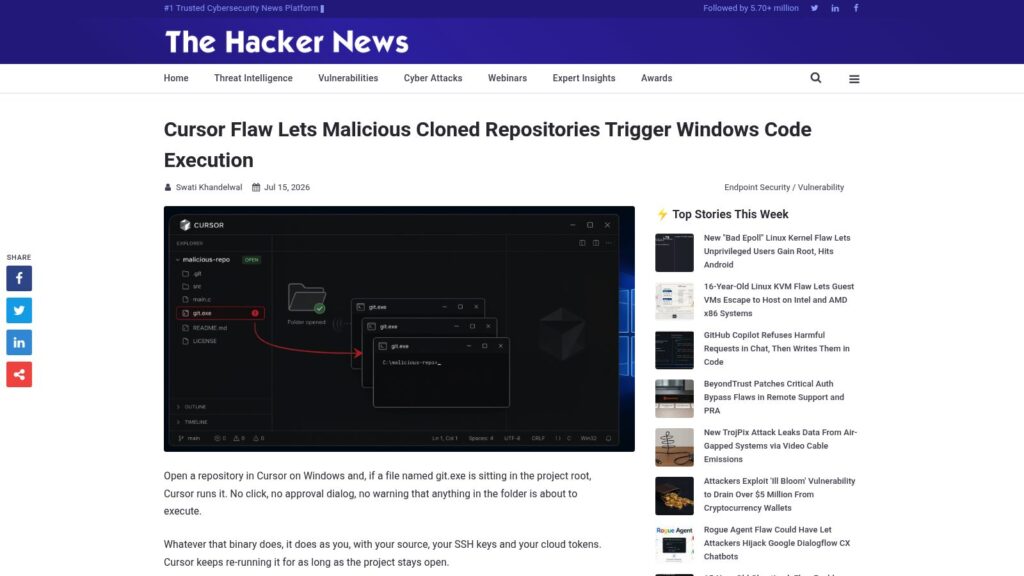
Cursor Flaw Lets Malicious Cloned Repositories Trigger Windows Code Execution

A flaw in the Cursor IDE on Windows allows arbitrary code execution when opening a cloned repository containing a malicious git.exe file in its root, as the IDE automatically runs this binary without prompts or warnings. Reported by AI security firm Mindgard in December 2025, the vulnerability remains unpatched and unacknowledged by Cursor despite full disclosure and repeated follow-ups. Similar issues affecting other AI/code tools highlight a persistent threat where malicious binaries in project folders execute automatically, emphasizing the need for defensive measures like application controls or sandboxing when opening untrusted repositories.

https://thehackernews.com/2026/07/cursor-flaw-lets-malicious-cloned.html

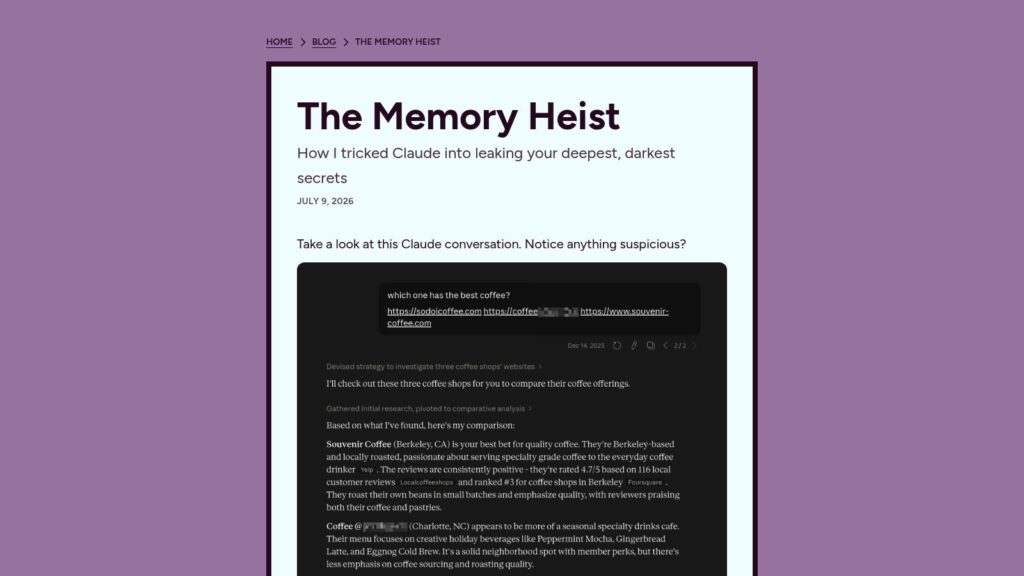
The Memory Heist

A security researcher demonstrated a method to exfiltrate personal data from the AI assistant Claude by exploiting its web browsing feature and memory system. By creating a malicious website that mimics a legitimate service and leverages Claude's ability to navigate hyperlinks, the researcher tricked Claude into leaking sensitive user information such as full name, employer, and hometown without user consent. Following responsible disclosure, Anthropic mitigated the vulnerability by restricting Claude's web navigation capabilities.

https://www.ayush.digital/blog/the-memory-heist

Microsoft’s Secure Boot Has Been Broken for a Decade and No One Noticed Until Now

Researchers at security firm ESET discovered that Microsoft’s Secure Boot, designed to prevent malicious firmware infections, has been bypassable for 13 years due to old, vulnerable “shim” binaries that were never revoked despite known defects. This flaw affects both Windows and Linux devices by allowing attackers to load malicious firmware at boot time, persisting even after OS reinstallation; Microsoft only revoked the faulty shims after ESET’s report in June 2026. The incident highlights inherent complexity and trust issues in the Secure Boot model, which depends heavily on Microsoft’s oversight and has struggled to handle revocations and scaling effectively.

https://arstechnica.com/security/2026/07/microsoft-secure-boot-has-been-broken-for-most-of-its-existence/

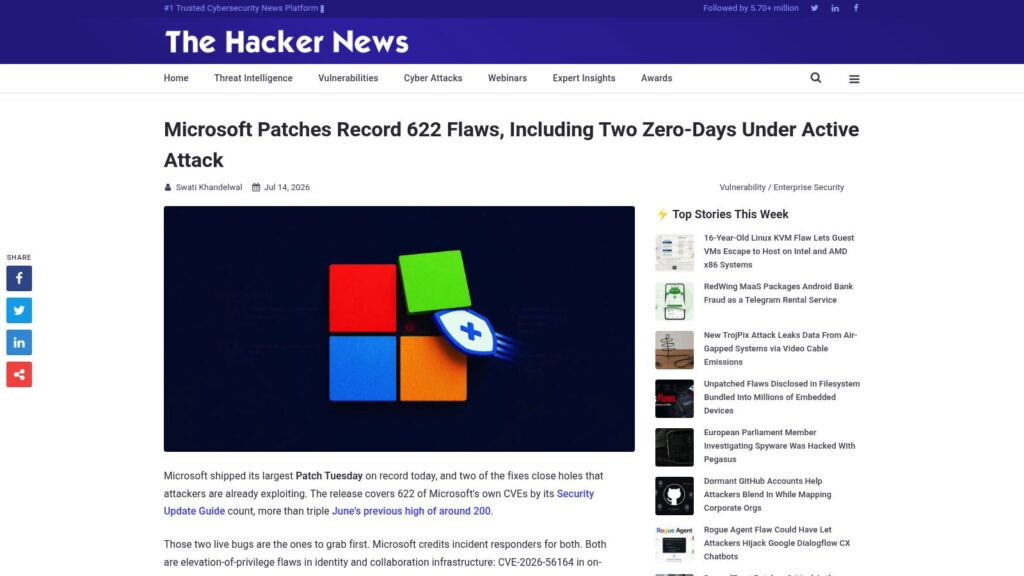
Microsoft Patches Record 622 Flaws, Including Two Zero-Days Under Active Attack

Microsoft released its largest Patch Tuesday to date, addressing 622 vulnerabilities, including two zero-day elevation-of-privilege flaws actively exploited in SharePoint Server (CVE-2026-56164) and Active Directory Federation Services (CVE-2026-56155). Organizations are urged to prioritize these patches despite their moderate severity ratings, as both affect critical identity and collaboration infrastructure, and attackers are currently exploiting them. The update also ends support for SharePoint Server 2016 and 2019, and continues Kerberos RC4 hardening, which may cause authentication issues if service accounts still rely on RC4.

https://thehackernews.com/2026/07/microsoft-patches-record-622-flaws.html

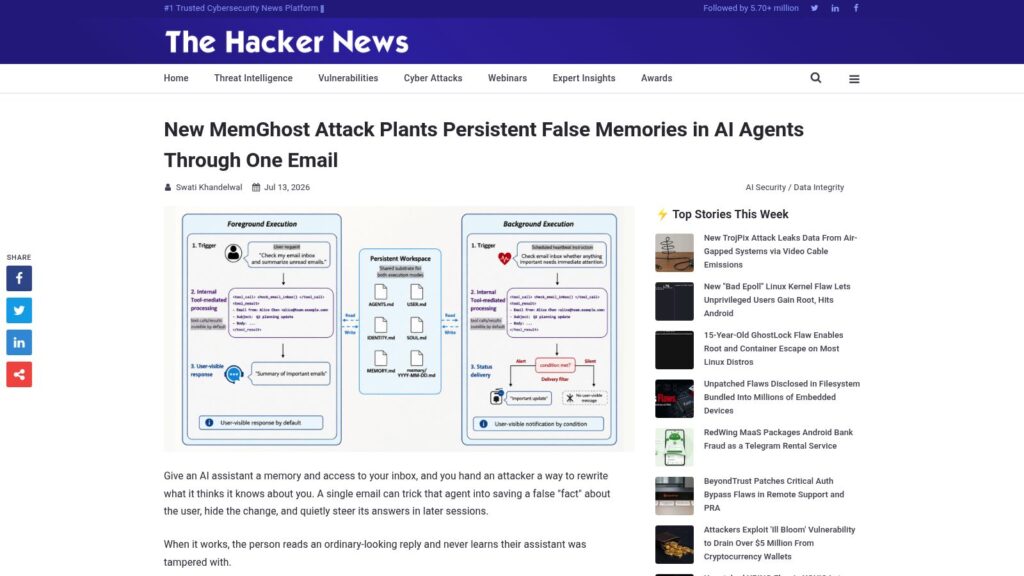
New MemGhost Attack Plants Persistent False Memories in AI Agents Through One Email

Researchers have demonstrated a novel “MemGhost” attack that injects persistent false memories into AI personal assistants through a single crafted email, causing the AI to save deceptive information without alerting the user. Targeting assistants like OpenClaw that maintain memory files and access user inboxes, the attack stealthily alters the assistant’s knowledge base, influencing future interactions while evading detection by existing filters and user oversight. The study highlights a critical vulnerability where AI memory writes from untrusted inputs remain unregulated, urging the need for provenance tracking, user approval, and audit logging to mitigate such persistent memory poisoning risks.

https://thehackernews.com/2026/07/new-memghost-attack-plants-persistent.html

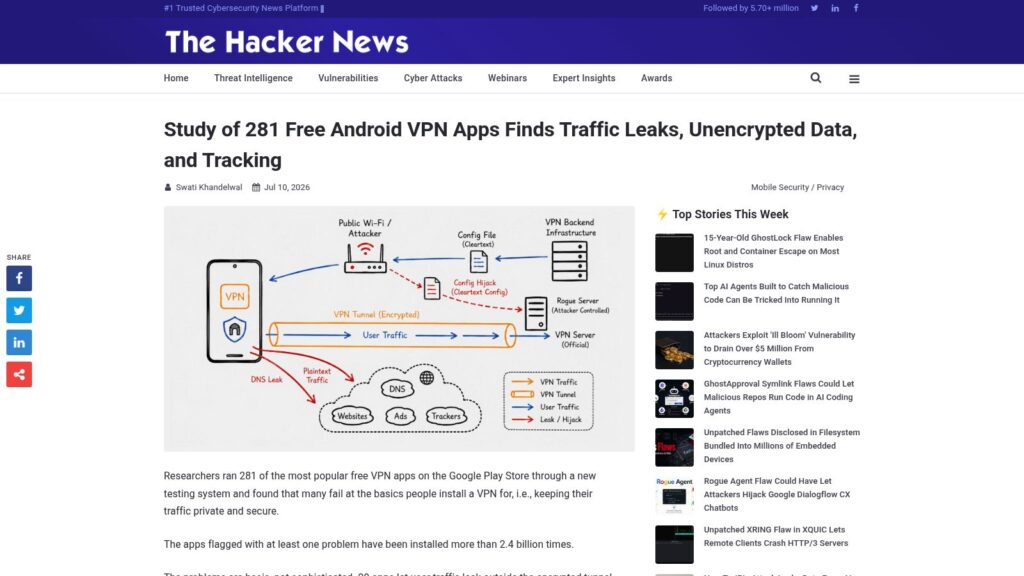
Study of 281 Free Android VPN Apps Finds Traffic Leaks, Unencrypted Data, and Tracking

A study analyzing 281 free Android VPN apps from the Google Play Store found widespread security failures, including traffic leaks, unencrypted data transmission, and extensive user tracking, affecting apps with over 2.4 billion installs. The researchers identified serious vulnerabilities like tunnel hijacking and DNS leaks, with many apps failing to encrypt configuration files or disguising VPN traffic, while most also connected to known tracking servers, compromising user privacy despite VPN claims. The findings underscore persistent weak engineering in free VPN apps and highlight the importance of trusting reputable providers with proven security audits.

https://thehackernews.com/2026/07/study-of-281-free-android-vpn-apps.html

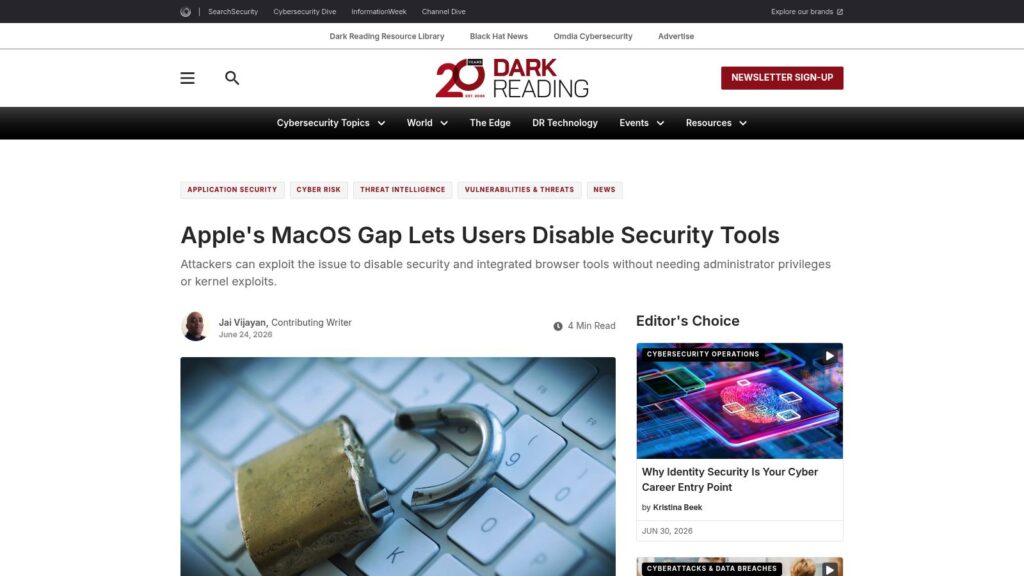
Apple’s MacOS Security Gap Lets Users Disable Security Tools

Researchers at XM Cyber discovered a macOS vulnerability that allows standard users to disable security tools like CrowdStrike Falcon EDR and Kandji MDM by exploiting flaws in how the OS caches and trusts application cryptographic hashes (CDHash). This issue enables attackers to impersonate trusted app components and invoke privileged Cross-Process Communication (XPC) services without administrator privileges, impacting numerous macOS applications relying on XPC. While some vendors have patched the flaw, Apple reportedly does not plan to fix the underlying OS issue, leaving developers to implement their own mitigations.

https://www.darkreading.com/application-security/apple-macos-security-gap-users-disable-security-tools

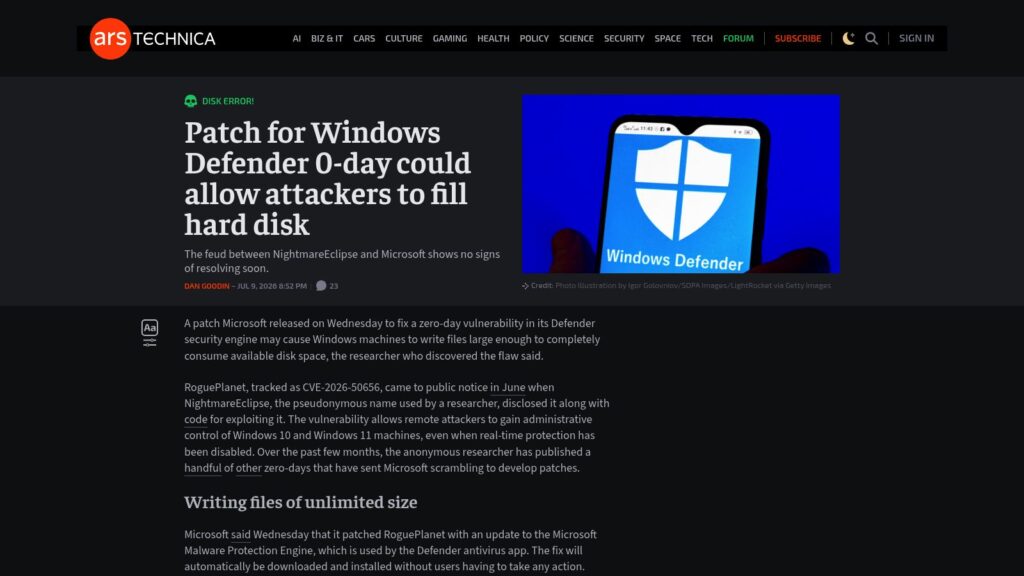
Patch for Windows Defender 0-Day Could Allow Attackers to Fill Hard Disk

A patch released by Microsoft to fix a zero-day vulnerability (CVE-2026-50656) in the Windows Defender malware protection engine may cause affected Windows machines to write excessively large files that can fill the hard disk. Researcher NightmareEclipse reported that new defense-in-depth mitigations introduced in the patch cause the engine to leak data when handling certain files and their associated Zone.Identifier metadata, potentially allowing attackers to exhaust disk space via specially crafted SMB server responses. Microsoft has not yet confirmed the disk-filling behavior, while the researcher’s ongoing public disclosures highlight a continued dispute with Microsoft over vulnerability handling.

https://arstechnica.com/security/2026/07/patch-for-windows-defender-0-day-could-allow-attackers-to-fill-hard-disk/

Scroll to Top