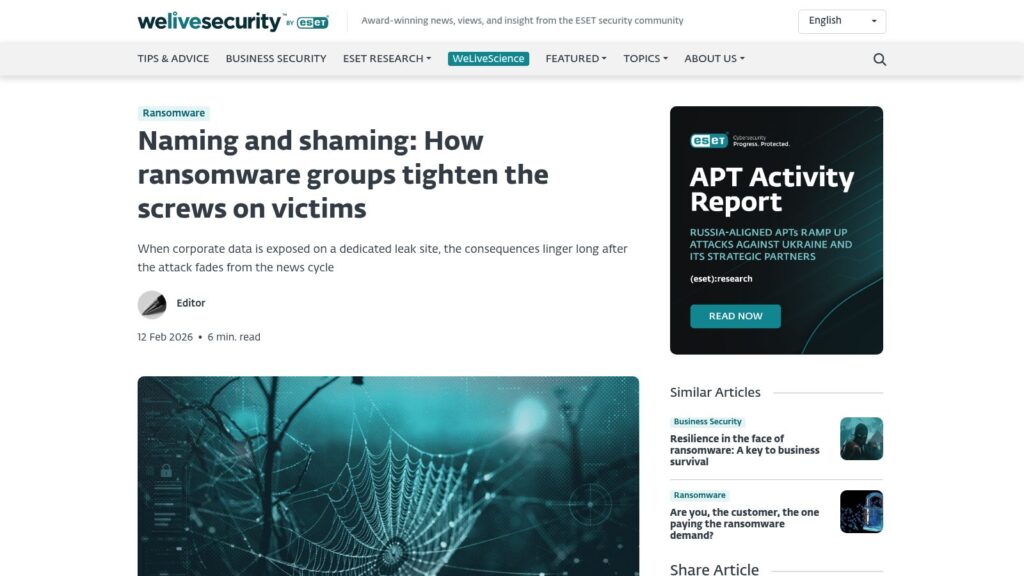
Defensible by Design: Ransomware and Cybersecurity in 2026

Ransomware is now a major concern for organizations, affecting strategy and leadership. CISOs face increasing pressure as ransomware evolves, requiring adaptability and focus on defensible, resilient systems over security illusions. Leadership development should involve real incident experiences and business-focused training. Traditional security budgets are insufficient, pushing for a shift towards recoverability and flexible response strategies. Investors now consider cybersecurity a key factor in funding decisions, linking security posture directly to organizational value. In 2026, success for CISOs will hinge on their ability to withstand and quickly recover from ransomware incidents.

https://www.halcyon.ai/blog/defensible-by-design-ransomware-and-cybersecurity-in-2026

The Hidden Risk in Virtualization: Why Hypervisors Are a Ransomware Magnet

Hypervisors, critical for virtual environments, are increasingly targeted by ransomware, particularly the Akira group. Attacks can risk numerous VMs simultaneously due to limited security visibility. Effective defenses include robust access controls, multi-factor authentication, hypervisor hardening, regular patching, and effective backup strategies. Organizations should also enhance monitoring for anomalous activities to detect potential breaches early and prepare for recovery scenarios, emphasizing a holistic security approach to protect hypervisors from escalating ransomware threats.

https://www.bleepingcomputer.com/news/security/the-hidden-risk-in-virtualization-why-hypervisors-are-a-ransomware-magnet/

Android Mobile Adware Surges in Second Half of 2025

Android adware surged in late 2025, with detections nearly doubling and malicious threats becoming more organized. Cybercriminals shifted from simple scams to sophisticated frameworks, employing tools like MobiDash and Triada for ongoing data theft and fraud. Users should prioritize mobile security by using trusted app stores, scrutinizing permissions, avoiding sideloaded apps, and employing real-time security software.

https://www.malwarebytes.com/blog/mobile/2025/12/android-threats-in-2025-when-your-phone-becomes-the-main-attack-surface

Most Parked Domains Now Serving Malicious Content

TLDR: Most parked domains now redirect to malicious sites, with over 90% leading to scams or malware, reversing a decade-old trend. Researchers at Infoblox found that users typing in expired or misspelled domains face increased risks, especially from residential IP addresses, which leads to deceptive content. Malicious redirects are linked to typosquatting domains mimicking popular sites, exposing users to potential malware and scams.

https://krebsonsecurity.com/2025/12/most-parked-domains-now-serving-malicious-content/

Should You Trust Your VPN Location?

Extreme TLDR: Analysis of 20 VPNs revealed 17 falsely claim exit locations; many are routed through different countries. 38 countries were only virtual, with data showing actual locations often thousands of kilometers away. Only 3 providers matched their claimed locations perfectly. Relying on self-reported data leads to significant inaccuracies. Users should treat “100+ countries” claims with skepticism and verify provider transparency regarding virtual versus physical server locations.

https://ipinfo.io/blog/vpn-location-mismatch-report

The 2025 Cloudflare Radar Year in Review- the Rise of AI, Post-quantum, and Record-breaking DDoS Attacks

Extreme TLDR: 2025 Cloudflare Radar reveals global Internet traffic rose 19%, driven by AI growth, Starlink doubling its traffic, and notable DDoS attacks. Key trends included 52% of Web traffic being post-quantum encrypted, 40% of bot traffic from the US, and Googlebot as the top traffic source. The Year in Review highlights shifts in popular services and connectivity issues, with significant growth in mobile and AI traffic.

https://blog.cloudflare.com/radar-2025-year-in-review/

Robot Safety Monitoring AI Market Reflects Growth at 21.2%

Robot Safety Monitoring AI market projected to grow from $2.7B in 2025 to $15.3B by 2034 (CAGR 21.2%). Norte America leads with >36.3% share. Enhances productivity, reduces workplace injuries, and creates jobs. Businesses face upfront costs but benefit from standardized safety solutions. Key sectors: manufacturing, logistics, automotive, healthcare. Future trends include predictive safety systems and increased automation. Strong demand for AI solutions in diverse industries, creating new business opportunities.

https://scoop.market.us/robot-safety-monitoring-ai-market-news/

Fraud Starts at Home

Virgin Money warns consumers to be vigilant against scams this festive season, stressing personal responsibility and simple security measures. Their head of fraud highlights that individuals are the first line of defense, advising to trust instincts, secure devices, and avoid sharing sensitive information. Research shows various fraud types target different generations, with a notable increase in online scams. Customers are urged to verify sources and check for website security before sharing payment details. The bank emphasizes common sense as key to staying safe online.

https://www.creditstrategy.co.uk/knowledge-hub/fraud-starts-at-home

Major Leak Reveals One of the Largest Lead-gen Databases Ever Exposed

A major data leak exposed 4.3 billion records, including LinkedIn-derived personal information, due to an unprotected MongoDB database. Researchers discovered 16TB of data, with details like emails, employment histories, and personal profiles. The leak poses significant security risks, enabling targeted phishing and social engineering attacks, as attackers can exploit this structured and current data. The incident underscores vulnerabilities in data management practices and highlights growing threats from extensive data leaks.

https://cybernews.com/security/database-exposes-billions-records-linkedin-data/

15+ Retail Cybersecurity Statistics for 2026: Threats and Protection

Retailers increasingly face cyber risks with data breaches averaging $10.22 million in the US. High transaction volumes, sprawling systems, and third-party dependencies make them prime targets. Major threats include phishing, malware, ransomware, and supply chain vulnerabilities. To combat these, retailers must adopt robust security measures, educate staff, and continuously monitor systems. Recent breaches, like those affecting Forever 21 and Neiman Marcus, highlight the need for strong risk management and third-party oversight.

https://www.shopify.com/enterprise/blog/retail-cybersecurity

Beware: PayPal Subscriptions Abused to Send Fake Purchase Emails

PayPal subscriptions are being exploited in a scam where fake purchase emails are sent, misleading people into believing they made expensive transactions. The emails, appearing legitimate, originate from “[email protected]” and include modified customer service URLs displaying fake purchase notifications. Scammers intend to instill fear, prompting recipients to call a fake PayPal support number. Although legit email formats are used, PayPal is working to mitigate this scam. Recipients are advised to ignore such emails and verify their account directly through PayPal.

https://www.bleepingcomputer.com/news/security/beware-paypal-subscriptions-abused-to-send-fake-purchase-emails/

Stop Hacklore!

Hacklore merges hacking and folklore, spreading digital safety myths rather than facts. Its aim is to debunk these myths for better understanding of real threats and effective safety measures, such as software updates and strong passwords. Emphasizes accurate, actionable advice for everyone.

https://www.hacklore.org/

Scroll to Top