ai

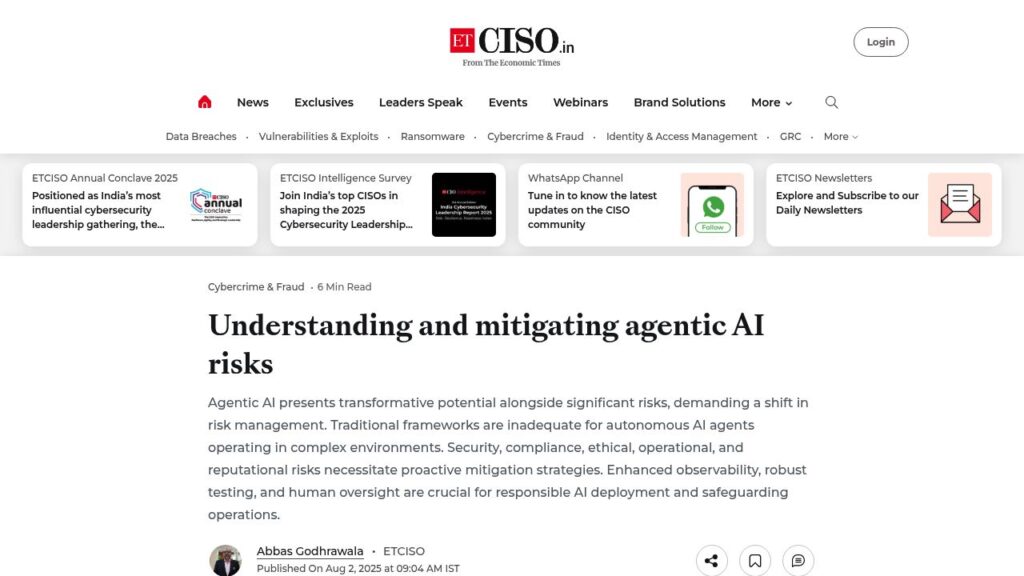
Navigating the Perils of Agentic AI: Essential Risk Management Strategies, ETCISO

Agentic AI holds transformative potential but introduces various risks that exceed traditional AI frameworks. These include security vulnerabilities, compliance challenges, ethical issues, operational unpredictability, and reputational threats. Proactive risk management is essential, emphasizing enhanced observability, robust testing, human oversight, and clear accountability. Organizations must adapt their strategies to address the evolving landscape, ensuring responsible AI deployment while safeguarding operations and reputation.

https://ciso.economictimes.indiatimes.com/news/cybercrime-fraud/navigating-the-perils-of-agentic-ai-essential-risk-management-strategies/123041904

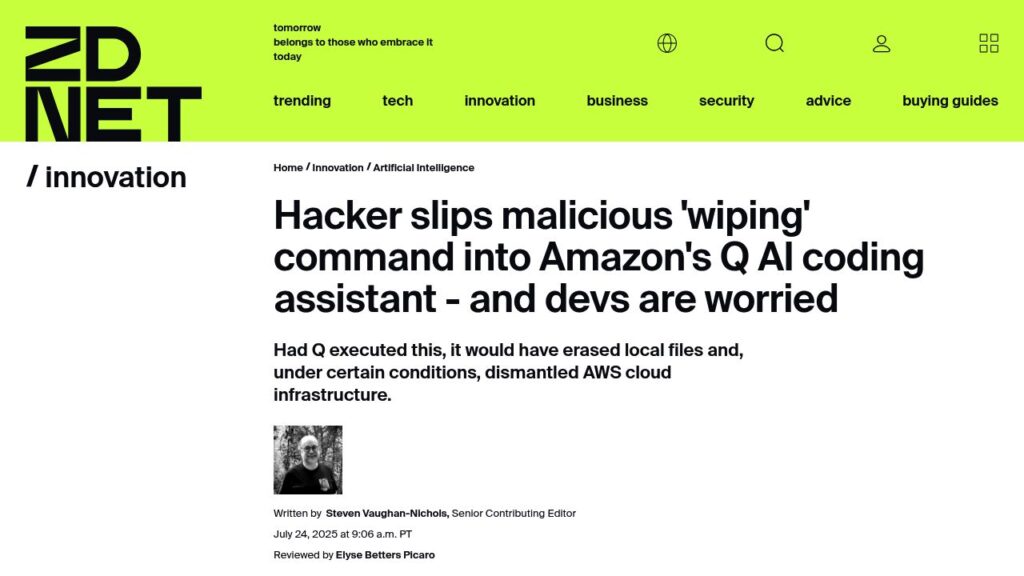
Hacker Slips Malicious ‘wiping’ Command Into Amazon’s Q AI Coding Assistant – and Devs are Worried

Hacker infiltrated Amazon's ‘Q' AI coding assistant, implanting a command that could potentially erase local files and dismantle AWS infrastructure. The malicious code passed Amazon's verification, causing developer concern and criticism over security practices. Amazon responded, claiming no customer resources were affected and stating security is a priority. However, the incident raised significant trust issues among developers, who demand more transparency and accountability.

https://www.zdnet.com/article/hacker-slips-malicious-wiping-command-into-amazons-q-ai-coding-assistant-and-devs-are-worried/

AI Has Broken Trust. Here’s How We’re Rebuilding It

AI has eroded trust in digital interactions. Rebuilding it requires prioritizing whether a user is a real human before verifying their identity through multi-factor authentication. Historical reliance on single-factor authentication has proven inadequate, especially with advancements in generative AI, with high-quality synthetic voices and abundant voice cloning models complicating security. Effective defense strategies now must focus on detecting synthetic identities prior to authentication processes, emphasizing the need for a robust, layered security approach.

https://www.pindrop.com/article/rebuilding-ai-broken-trust/

McDonald’s AI Breach Reveals The Dark Side Of Automated Recruitment

McDonald's AI hiring system, McHire, suffered a significant breach exposing millions of job applicants' personal data due to serious security flaws, including weak passwords and unregulated access. Researchers accessed sensitive information by simply using default login credentials, highlighting the inadequacy of basic security practices. The incident exposes a broader trend where rapid technology deployment often neglects essential security measures, indicating that companies must prioritize safeguarding personal data amidst automation efforts.

https://www.forbes.com/sites/tonybradley/2025/07/15/mcdonalds-ai-breach-reveals-the-dark-side-of-automated-recruitment/

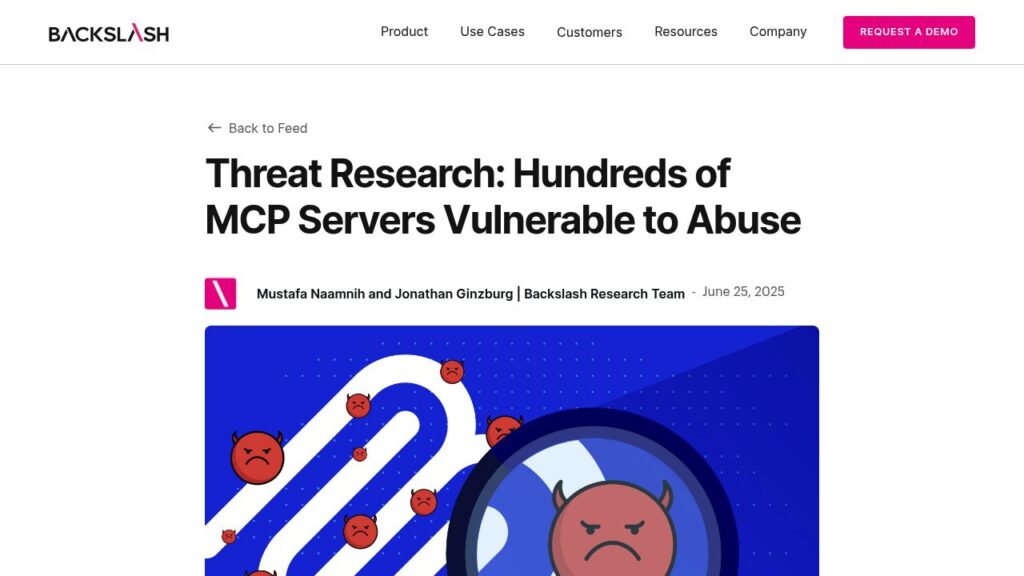
Threat Research: Hundreds of MCP Servers Vulnerable to Abuse

Summary: Backslash's research reveals that many Model Context Protocol (MCP) servers are vulnerable due to misconfigurations, exposing them to various security risks like unauthorized access, command execution, and data exfiltration. Key issues identified include network exposure allowing access from any local device, and excessive permissions permitting arbitrary commands on host machines. This vulnerability combination can lead to total control by an attacker. Users are advised to consult the Backslash MCP Security Hub for server safety, while developers should implement best practices for securing MCPs against these risks.

https://www.backslash.security/blog/hundreds-of-mcp-servers-vulnerable-to-abuse

Cybercriminal Abuse of Large Language Models

Cybercriminals exploit large language models (LLMs) for illicit activities, using uncensored models or creating their own to bypass safety features. They employ these models for tasks like generating phishing emails, scanning vulnerabilities, and writing malware. Techniques like jailbreaking and obfuscation allow them to manipulate legitimate LLMs for harmful purposes. Cybercriminals also face risks of scams when accessing fraudulent LLM services. As LLM technology evolves, it serves as a tool for enhancing traditional cyber threats.

https://blog.talosintelligence.com/cybercriminal-abuse-of-large-language-models/

AI Is a Data-breach Time Bomb, Reveals New Report

New report warns that AI presents significant data-breach risks, with 99% of organizations exposing sensitive information to potential AI misuse. Inadequate security measures, such as unverified apps and poor MFA practices, increase vulnerability. Recommendations include reducing risk exposure, continuous monitoring, and leveraging AI for security enhancements. No organization is fully prepared for these threats.

https://www.bleepingcomputer.com/news/security/ai-is-a-data-breach-time-bomb-reveals-new-report/

How Global Threat Actors Are Weaponizing AI Now, According to OpenAI

OpenAI's recent report highlights misuse of generative AI tools, primarily from actors in China, involved in producing misinformation and engaging in cyber activities. Specific examples include creating social media posts to influence political discourse and unauthorized cyber intrusions. The report emphasizes the ongoing arms race between developers and malicious users, amidst concerns about regulatory gaps in the US.

https://www.zdnet.com/article/how-global-threat-actors-are-weaponizing-ai-now-according-to-openai/

Scientists Use AI to Encrypt Secret Messages That Are Invisible to Cybersecurity Systems

Scientists have developed a method using AI to encrypt messages within fake text, rendering them invisible to cybersecurity systems. This technique allows secure communication, particularly for journalists and citizens in oppressive regimes, by embedding secret messages that can only be accessed with a password. Dubbed EmbedderLLM, the method acts like digital invisible ink, but the ethics of its use remain a concern. The encryption is designed to resist future quantum computing decryption threats.

https://www.livescience.com/technology/artificial-intelligence/scientists-use-ai-to-encrypt-secret-messages-that-are-invisible-to-cybersecurity-systems

Three Ways AI Can Weaken Your Cybersecurity

AI can weaken cybersecurity through three main methods:

  1. Slopsquatting – Spreading malware via hallucinated software libraries recommended by AI, often targeting users who mistype URLs.
  2. Prompt Injection – Attackers inject malicious prompts into AI applications, potentially leading to unauthorized information access or code execution.
  3. Data Poisoning – Manipulating training data to skew AI model outputs, which poses risks for various industries.

These tactics exploit the vulnerabilities of AI systems, emphasizing the need for increased vigilance and adapted security measures.

https://www.bigdatawire.com/2025/04/25/three-ways-ai-can-weaken-your-cybersecurity/

The Rise of Slopsquatting: How AI Hallucinations Are Fueling…

Slopsquatting is a new supply chain attack using AI-generated nonexistent package names, making it easier for attackers to exploit developer trust in AI tools. Research shows significant hallucination rates in code generation models, with 19.7% of suggested packages being fake. This poses serious risks as developers may unknowingly install these malicious packages, especially with the growing trend of “vibe coding” where developers rely heavily on AI for code creation. Security measures must adapt to identify and mitigate these threats effectively to protect software ecosystems.

https://socket.dev/blog/slopsquatting-how-ai-hallucinations-are-fueling-a-new-class-of-supply-chain-attacks

FBI Warning For All iPhone, Android Users—Hang Up Now, Use This Code

FBI warns iPhone and Android users about AI-powered deepfake scams. Users should hang up on suspicious calls and create a secret code for verification with close family to combat voice cloning threats. Social media poses risks as it provides voice samples for cybercriminals. Ongoing AI attacks are reshaping crime, making scams increasingly sophisticated and difficult to detect.

https://www.forbes.com/sites/daveywinder/2025/03/22/fbi-warns-iphone-and-android-users-hang-up-now-use-this-code/

Jailbreaking Is (mostly) Simpler Than You Think

Microsoft's blog discusses a straightforward jailbreak method, Context Compliance Attack (CCA), effective against many AI systems. CCA manipulates AI by exploiting reliance on client-supplied conversation history, allowing for context manipulation with minimal effort. Models maintaining conversation state, like Copilot and ChatGPT, are safe from this attack. Microsoft suggests enhancements like cryptographic signatures and server-side history to bolster AI safety. The implications of CCA stress the need for comprehensive security considerations in AI system designs, encouraging discussions on further mitigation strategies.

https://msrc.microsoft.com/blog/2025/03/jailbreaking-is-mostly-simpler-than-you-think/

New AI Protection From Google Cloud Tackles AI Risks, Threats, and Compliance

Google Cloud launched AI Protection, enhancing security for generative AI with capabilities to discover AI assets, secure them, and manage associated threats. It integrates with Google’s Security Command Center for comprehensive risk management and regulatory compliance. Key features include automatic inventory discovery, prompt injection prevention, and threat detection, providing a broader security platform to mitigate AI-related vulnerabilities.

https://www.securityweek.com/new-ai-protection-from-google-cloud-tackles-ai-risks-threats-and-compliance/

Nearly 12,000 API Keys and Passwords Found in AI Training Dataset

Nearly 12,000 API keys and passwords were discovered in the Common Crawl dataset used to train AI models, raising concerns about insecure coding practices. Researchers found 11,908 valid secrets after examining 400 terabytes of data from billions of web pages. Among these were AWS and MailChimp keys, often hardcoded into HTML and JavaScript. Vulnerabilities include potential misuse for phishing and data exfiltration. The study highlights the challenge of removing sensitive information from large datasets despite pre-processing efforts.

https://www.bleepingcomputer.com/news/security/nearly-12-000-api-keys-and-passwords-found-in-ai-training-dataset/

Scroll to Top